Blog · Data · 5 min
The myth of countries with more women: what the numbers say by age group
Latvia and Ukraine do have more women than men, but only from the mid-forties up. Younger, men outnumber women. The cause is life expectancy, not a dating market.
Content checked against sources, waiting for an editor's sign-off. Not indexed yet.
There is a recurring corner of the internet that tells men to book a flight to Riga or Kyiv because "there are more women there". The starting number is real. The advice built on it is not. We went back to the sources, split the data by age, and the picture turns upside down.
A note on method first. Throughout this piece we write "men per 100 women", even when a source counts the other way, so the figures compare. And we don't publish a sex ratio without saying what drives it.
Where the claim comes from: Latvia
On 1 January 2020 Latvia had the highest ratio of women to men in the EU: 117.3 women per 100 men, or about 85 men per 100 women. Lithuania came next, with 14% more women than men. The EU average was 104.7 women per 100 men.1
That's the headline. Now open it up.
The same country, by age
Estimates for 2026 based on the UN's World Population Prospects 2024 put Latvia at 86.8 men per 100 women overall. In the younger groups it runs the other way: 105.6 at ages 20 to 24, 107.5 at 30 to 34, still 103.5 at 40 to 44. The ratio only drops below 100 at 45 to 49 (97.5). It reaches 80 at 60 to 64 and 52.9 among people over 65.2
Latvia's national statistics office says the same thing with a slightly different age: men stay in the majority until 35 to 40, after which women take over because they live longer.3 The two sources disagree on the exact crossover, most likely because they describe different years. They agree on the point that matters. Between 20 and 40 there is no surplus of women.
Ukraine follows the same shape. The 2026 estimate is 87.1 men per 100 women overall, yet men outnumber women in every five-year group up to 40 to 44. The ratio falls to 94.3 at 45 to 49 and to 53.6 above 65.4 One extra caution: population estimates for a country at war carry wide uncertainty.
| Age band | Latvia, 2026 estimate | Ukraine, 2026 estimate |
|---|---|---|
| 20-39 | between 105 and 108 men per 100 women | above 100 in every group |
| 40-59 | from 103.5 (40-44) to 86.7 (55-59) | above 100 up to 44, 94.3 at 45-49 |
| 60+ | 80 at 60-64, 52.9 above 65 | 53.6 above 65 |
The sources publish five-year groups. We grouped them without recalculating, which is why some cells show a range rather than a single figure.
The cause: how long people live
In 2024, life expectancy at birth in the EU was 84.1 years for women and 78.9 for men, a gap of 5.2 years. In Latvia the gap is 9.8 years, the widest in the Union.5
Nearly a decade of extra life, across a whole population, is enough to produce the headline number by itself. Each generation is born with slightly more boys (that happens everywhere), stays roughly balanced through young adulthood, then becomes majority female as it ages. The "country with more women" is to a large extent a country with many older women, many of them widowed.
Put plainly, the figure measures male mortality. It doesn't measure how many young women live there, how many are single, or whether any of them want to meet a tourist.
The mirror image: the Gulf
At the other end sit the Gulf states. UN-based estimates for 2026 give Qatar 243.7 men per 100 women, the United Arab Emirates 175 and Oman 166.5.6
The driver is labour migration. In national data compiled by the Gulf Labour Markets and Migration programme, Qatar's employed non-nationals at the end of 2013 included 803 men for every 100 women, against 206 among employed Qatari nationals.7 Those figures are more than ten years old and the source itself points readers to national statistics offices for newer ones. The mechanism still holds: the imbalance sits in a working-age population that arrived from abroad, mostly men employed in construction and services.
Three mistakes to avoid with these numbers
Mixing up sex and marital status. A sex ratio counts people. It doesn't tell you who is married, who lives with a partner or who lives alone.
Mixing up living alone and being single. Eurostat records strong growth in households made of one adult without children: up 19.2% between 2016 and 2025 across the EU, against 6.0% for all households, to 76.1 million.8 A one-adult household might be a widowed 80-year-old or a student. It isn't a map of single people.
Jumping from a ratio to availability. None of these statistics says anything about who is open to meeting someone. A site that implies otherwise is selling something other than travel.
So what does matter on a solo trip?
If your goal is meeting people, demography won't help much. In Hostelworld's 2026 report, which surveyed 3,309 solo travellers, 37.3% gave "meeting new people" as a reason for travelling alone.9 What makes that happen is hostels with events, walking tours, language exchanges and bars where sitting alone at the counter is normal.
That's why demographics carry little weight in our Solo Score: 3 points out of 100 in the default profile, none for first-time solo travellers. The full method is on the Solo Score page.
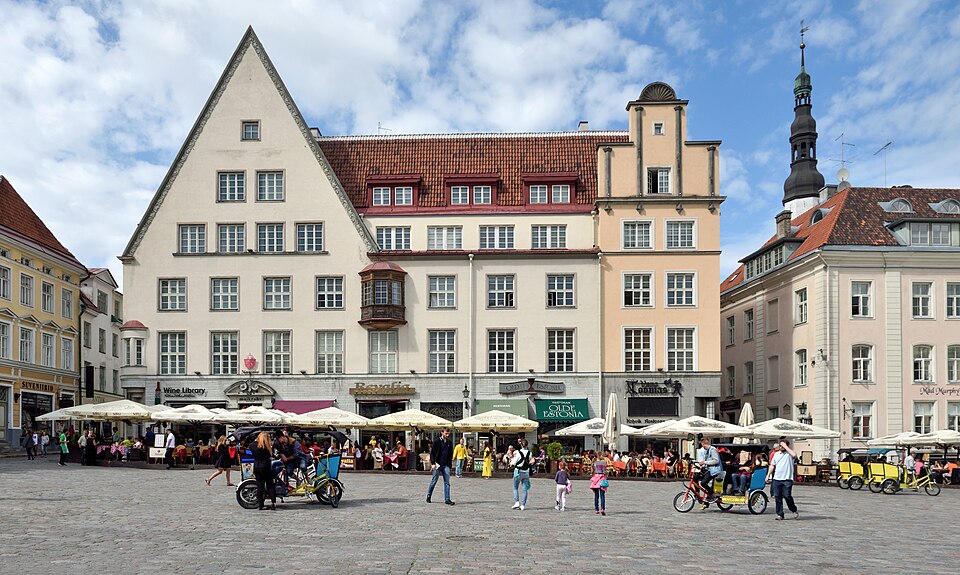
If the Baltics are on your list, our Tallinn page covers neighbourhoods, late transport and ways to meet people. For an easy first solo city, Lisbon and Berlin are built the same way: facts, sources, dates.
How we'll publish this from now on
When our single-person data map goes live, each country will show the ratio of men to women for ages 20-39, 40-59 and 60+, with year and source, plus the cause of any imbalance. No "where to find" headlines. If a number looks wrong to you, the Corrections page explains how to flag it.
Frequently asked questions
Which European country has the most women compared with men?
In Eurostat data for 1 January 2020 it was Latvia, with roughly 85 men per 100 women, followed by Lithuania. Almost all of that gap is above age 45. Between 20 and 44, Latvian men outnumber women.
Why are there more women than men in Eastern Europe?
Because women live much longer. Latvia's gap in life expectancy at birth is 9.8 years, the widest in the EU according to Eurostat's 2024 figures. The female surplus is an effect of old age.
Which countries have the most men compared with women?
The Gulf states. Qatar, the UAE and Oman have the highest ratios in the world in 2026 estimates based on UN data, because so much of their workforce is made up of male migrant workers.
Does the sex ratio tell you how many people are single?
No. It counts men and women. It says nothing about who is married, who lives alone or who wants to meet anyone. Marital status needs census data, read by age.
Sources
- Latvia has highest ratio of women to men in the EU (dati Eurostat al 1° gennaio 2020), LSM (Latvian Public Broadcasting) · media · accessed 27 October 2026
- Latvia sex ratio (elaborazione su UN World Population Prospects 2024), StatisticsTimes · study · accessed 27 October 2026
- Population by age and sex, Official Statistics Portal of Latvia (CSP) · official source · accessed 27 October 2026
- Ukraine sex ratio (elaborazione su UN World Population Prospects 2024), StatisticsTimes · study · accessed 27 October 2026
- Mortality and life expectancy statistics, Eurostat · official source · accessed 27 October 2026
- Countries by sex ratio 2026 (elaborazione su UN World Population Prospects 2024), StatisticsTimes · study · accessed 27 October 2026
- Employed national and non-national populations by sex and sex ratios in GCC countries, Gulf Labour Markets and Migration (Gulf Research Center) · study · accessed 27 October 2026
- Household composition statistics, Eurostat · official source · accessed 27 October 2026
- The 2026 State of Solo Travel Report, Hostelworld · study · accessed 27 October 2026
- Sources: 9
Places in this article



Read next